Marrakech is one of the most exciting cities in the world — and one of the most overwhelming for first-time visitors. The Medina's winding alleyways, the sensory overload of Jemaa el-Fna, the heat, the haggling. It can feel like a lot. But with a little preparation, it becomes pure magic. Here's what you actually need to know.
1. Sort Your Cash Before You Leave the Airport
Morocco uses the Moroccan Dirham (MAD). You cannot bring dirhams into the country legally, so you'll need to exchange money on arrival or withdraw from an ATM.
Best approach: Use an ATM at the airport — rates are generally fair, and fees are predictable. Exchange bureaux at the airport exist but rates vary.
Rough guide: 1 EUR ≈ 10–11 MAD | 1 GBP ≈ 12–13 MAD | 1 USD ≈ 9–10 MAD
Keep small bills — 20 and 50 MAD notes. Vendors often claim they have no change.
2. Get a Local SIM Card
Moroccan network coverage is good throughout the country. Pick up a prepaid SIM at the airport or from any telecom shop in the Medina. Maroc Telecom and Orange are the main providers. A data-only SIM with several gigabytes costs around 50–100 MAD.
Having data means you can navigate the Medina's maze, call your riad, and use Google Maps — all essential for first-timers.
3. Dress Respectfully
Morocco is a Muslim country. In tourist areas, the dress code is relaxed by local standards, but dressing modestly goes a long way:
- Cover shoulders and knees, especially when entering mosques or souks
- Women are not required to cover their hair, but doing so in religious sites is respectful
- Swimwear belongs by the pool, not in the streets
4. Learn a Few Words
Arabic and Darija (Moroccan Arabic) are the main languages. French is widely spoken in tourism and business. Spanish is useful in northern Morocco.
A few phrases that earn goodwill:
- La shukran — No thank you (useful in souks)
- Shukran — Thank you
- Bslama — Goodbye
- Bzzaf — Too much (in price negotiation)
5. Jemaa el-Fna Is Worth It — Go at Dusk
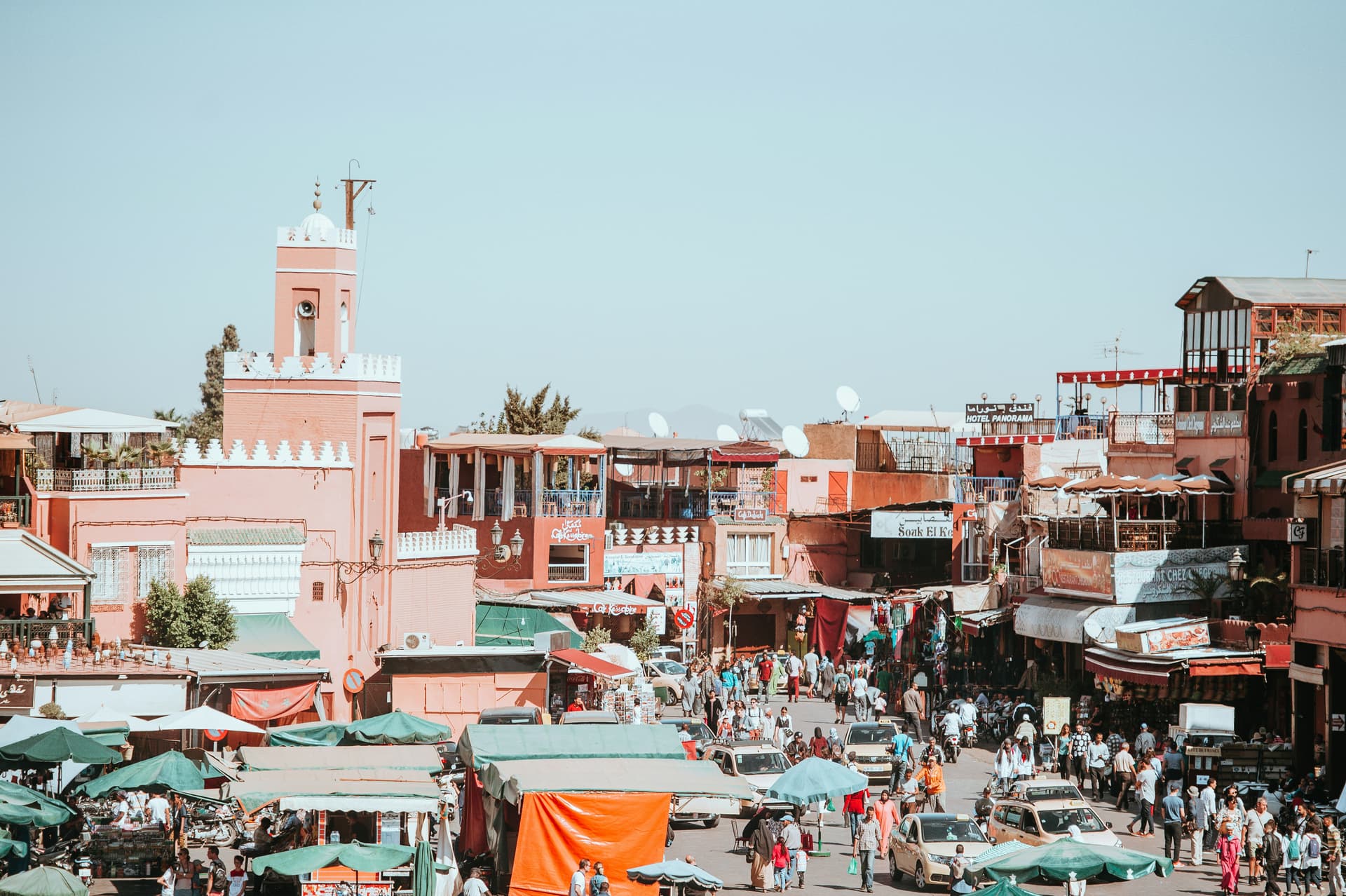
The main square is genuinely spectacular at sunset when the food stalls open and the square fills with storytellers, musicians, and snake charmers. Go for the atmosphere, not for the food (see tip #9).
Walk through without making eye contact with performers if you don't want to be called over. If you stop and watch, a tip will be expected — 10–20 MAD is fair.
6. The Medina Is a Maze (and That's Fine)
The Medina has over 18 km of alleyways. You will get lost. That's part of the experience. A few tips:
- Download Google Maps offline before you go — it's reasonably accurate in the Medina
- Note the name of your riad and the nearest landmark or Medina gate (bab)
- Your riad staff can usually send someone to meet you if you're truly lost
7. Understand the Taxi System
Marrakech has two types of taxis:
- Petit taxi (small, red): metered, for city trips, max 3 passengers. Always insist on the meter: "Compteur, s'il vous plaît."
- Grand taxi (large, beige): fixed routes, negotiated price, used for airport and inter-city travel
For the airport, the official rate to the Medina is 50–80 MAD (day) and 75–120 MAD (night). Agree the price before getting in.
Alternatively, book a private transfer — the price difference is small, but the experience (name sign, door-to-door, no negotiation) is significantly better.
8. Souk Shopping: Haggling Is Expected
Prices in the souks are not fixed. The opening price is almost always inflated — sometimes 3–5x. A few rules:
- Never accept the first price
- Walk away if you're not happy — often they'll call you back with a better offer
- Don't feel pressured. If you're not interested, a firm "la shukran" (no thank you) usually works
- Know roughly what something is worth before you engage (ask your riad in advance)
9. Street Food: What's Safe, What Isn't
The food stalls on Jemaa el-Fna are atmospheric but variable in quality. Locals often prefer the small restaurants inside the souks.
Generally safe: Tagine from restaurants, couscous, msemen (flatbread), fresh orange juice (squeezed in front of you), kefta sandwiches from busy stalls.
Be cautious with: Raw salads, cold dishes left out, anything at a stall that doesn't have a busy queue.
The golden rule: Eat where locals eat. If the place is empty, keep walking.
10. Drink Bottled Water
Tap water in Marrakech is technically treated but not recommended for visitors who aren't accustomed to it. Buy bottled water (widely available, 5–10 MAD for 1.5L) and use it for drinking and brushing teeth.
11. Tipping Culture
Tipping is expected but not obligatory. General guides:
| Service | Suggested Tip |
|---|---|
| Restaurant (sit-down) | 10–15% |
| Taxi | Round up to nearest 5 MAD |
| Riad staff | 50–100 MAD total for a short stay |
| Porter / guide | 20–50 MAD |
| Street performer | 10–20 MAD if you stopped to watch |
12. Start with a Private Airport Transfer
Your arrival sets the tone for the trip. A chaotic, overpriced taxi negotiation after a long flight is not a great start.
Booking a private transfer in advance means someone with your name on a sign is waiting when you clear customs. The price is fixed, the car is clean and air-conditioned, and you'll be at your riad in 20 minutes without any stress.
Book your Marrakech airport transfer →
Weather in Marrakech by Month
| Month | High °C | Low °C | Notes |
|---|---|---|---|
| Jan–Feb | 18–20 | 5–7 | Cold nights, pack layers |
| Mar–Apr | 22–26 | 9–12 | Ideal — warm days, cool evenings |
| May–Jun | 28–34 | 14–18 | Getting hot, book early |
| Jul–Aug | 38–42 | 20–24 | Very hot — plan for siesta hours |
| Sep–Oct | 30–35 | 16–19 | Still warm, excellent weather |
| Nov–Dec | 20–22 | 7–10 | Pleasant, fewer crowds |
The best months to visit are March–April and September–October.